Get the Course

One Frame AI Studio

Make cinematic AI videosin 3 simple steps

Build a unique AI film in 3 simple steps.
No experience needed.

Get the Course
Scroll

The Oneframe System

One clear path from idea to film.

A simple creative system for turning any idea into a cinematic AI film.

01

Shape the Story

Oneframe Story-Tuning Method

Use the exclusive Oneframe Story-Tuning Method to turn any idea into a cinematic story with blockbuster-level structure — without writing a full, complicated screenplay.

02

Build the World

Oneframe Reference Skill

Use my custom-tuned SKILL to create blockbuster-quality prompts for realistic, consistent characters and scenes.

03

Direct the Film

Oneframe Video Direction Skill

Use my custom-tuned SKILL to turn your scenes into polished, cinematic video without complex prompt-writing.

Three films below. The same system behind each.

See What's Possible

Beneath the Vows — Episode 8

A new story brought to life with the same 3-step system.

How This Film Was Built

The same creative logic works for every story, scene, and world.

Process 01

Story Blueprint

Turn your own idea into a clear cinematic story.

Outline 01

4s — 85mm Upper-body two-shot of A and C. A is on the right, her body turned left as she looks down toward B, who is lying on the ground off-screen at the lower left. C looks at A in confusion, occasionally glancing toward B. Shocked and bewildered, C asks A, “What happened?” She then quickly walks toward B. A looks terrified and breathes heavily. 3s — 85mm Low-angle shot with B’s blurred head in the foreground, looking slightly upward at C. C walks over and crouches beside B. Slightly shocked, she slowly reaches out and checks whether B is breathing. 4s — 85mm Over-the-shoulder shot with C on the right, looking down at B’s head and shoulders. B lies unconscious and completely motionless on the ground. C breathes a sigh of relief and says, “Thank God. He’s still alive.” 4s — 85mm Upper-body two-shot of A and C, with A on the right. A looks frightened and distracted, staring down toward B off-screen. C slowly stands and turns toward A. Confused, she asks, “My child, what happened? Why is Henry—” Before C can finish, A suddenly interrupts her. Looking frightened but as though a thought has just occurred to her, A says, “Head Maid…” 4s — 85mm Head-and-shoulders close-up of A. Still frightened and deep in thought, she slowly looks toward C and says, “You can’t tell them you were the one who struck him.” 5s — 85mm Over-the-shoulder shot with A on the right, framing C’s upper body. C looks at A in confusion and replies, “Of course I struck him. He was clearly going to hurt you…” A urgently steps closer to C. 5s — 85mm Side-profile head-and-shoulders two-shot, with C on the left and A on the right. Half grateful and half anxious, A looks at C and says, “There’s no time. I can’t drag you into this too…” 0.5s — CONTINUATION SHOT Wide shot.

Outline 02

5s — 85mm Low-angle shot with the unconscious B blurred in the foreground, looking slightly upward at the upper bodies of A and C. C is on the left and A is on the right. Grateful but anxious, A says, “Vanessa is behind Henry. She’ll come after you!” A continues breathing heavily. 5s — 85mm Head-and-shoulders shot of C. Displeased, C shakes her head and says, “My child, I’ll explain everything…” She is interrupted by several guards shouting in the distance as their rapidly approaching footsteps can be heard. “Where is the intruder?!” C turns her head slightly toward the right. 5s — 85mm Over-the-shoulder shot with C on the left. C looks off-screen to the left and calls out loudly, “Over here!” A’s upper body is visible on the right. She looks anxious, her eyes darting around as she breathes heavily. The guards’ approaching footsteps grow louder. After two seconds, A’s expression suddenly turns sorrowful. She abruptly charges at C and knocks her out of frame. C lets out a soft cry of pain. A quickly crouches and exits the frame through the lower-right corner. 2s — 85mm Overhead close-up of the wooden club on the ground. A’s hand quickly enters from the top of the frame, grabs the club and pulls it out of frame. In pain, C shouts, “Amelia!” The guards’ rapidly approaching footsteps grow even louder. 13 4s — 85mm Low-angle shot with C lying in the left foreground. She looks toward A off-screen at the upper right and asks in confusion and pain, “What are you doing?!” At that moment, a single guard runs into frame from the left side of the palace doorway. He briefly glances at C, then looks beyond the camera in shock and exclaims, “Lord Henry?!” He immediately hurries toward the camera. 6s — 85mm Over-the-shoulder shot with the fallen C’s head and shoulder in the left foreground, looking slightly upward at A. A grips the wooden club with both hands. She looks terrified, her eyes darting from side to side as she breathes heavily. A second guard quickly enters through the archway on the left. When he sees A, he freezes for a moment before immediately drawing his sword and assuming a combat stance. Furious, he roars, “Drop the weapon!” At the same time, C cries out in pain, “Wait! No—she didn’t do this!” Still breathing heavily, A looks at the guard with a mixture of sorrow and fear. Holding the club in both hands, she backs away half a step, unsure of what to do. Ignoring C completely, the guard keeps his sword raised and slowly advances toward A. 0.5s — CONTINUATION SHOT Wide shot.

Outline 03

REFERENCE F stands in front of the chair. Eight nobles stand behind it, whispering among themselves so quietly that they are almost inaudible. 3s — 85mm Top-down shot of B’s upper body. B lies unconscious and completely motionless on a stretcher carried by two people. The stretcher moves toward the bottom of the frame as the camera tracks with it. 4s — 85mm F stands in front of the chair. The stretcher enters from the right foreground and stops in front of him. Slightly low-angle upper-body shot of F. He looks sternly at the unconscious B and asks, “How is he?” 4s — 85mm Over-the-shoulder shot with F on the left, looking down at B on the stretcher. F reaches out with his right hand and checks B’s breathing. An off-screen male voice replies respectfully, “My lord, he merely fainted. He should wake before long.” F looks forward. The stretcher is then carried out of frame to the right. 4s — 85mm Frontal waist-up shot of F. He sighs, sits down in the chair and rubs his left temple in frustration. With an authoritative and displeased expression, he asks, “Where is the prisoner?” 4s — 85mm Ground-level shot. Two guards, one on each side, seize A by the arms and drag her into frame from the right. They force her violently to the floor, making her knees strike the ground hard as she kneels before F off-screen. One of the guards snarls, “Behave yourself!” Begin with a close-up of A’s knees, then slowly tilt the camera upward. A’s hands are bound behind her back. The two guards exit separately through the right side of the frame. Frame A’s upper body. She looks sorrowful and resentful as she raises her eyes toward F off-screen in front of her. 11 4s — 85mm Over-the-shoulder shot with A on the right, looking slightly upward at F seated in the chair. F glances at A before slowly asking in a stern, authoritative voice, “Why did you attack—” Before he can finish, C interrupts respectfully from off-screen. “My lord.” F looks behind A. 4s — 85mm A’s blurred, front-facing head and shoulders fill the right foreground while C’s upper body remains in focus. C enters from the right behind A and stops just behind A’s right shoulder, facing F off-screen directly ahead. C dips into a small, respectful curtsy and says, “My lord, the truth is…”

+ See how this was madeMore detailed steps inside the course
Process 02

Build the World

Create references that make characters and scenes feel consistent.
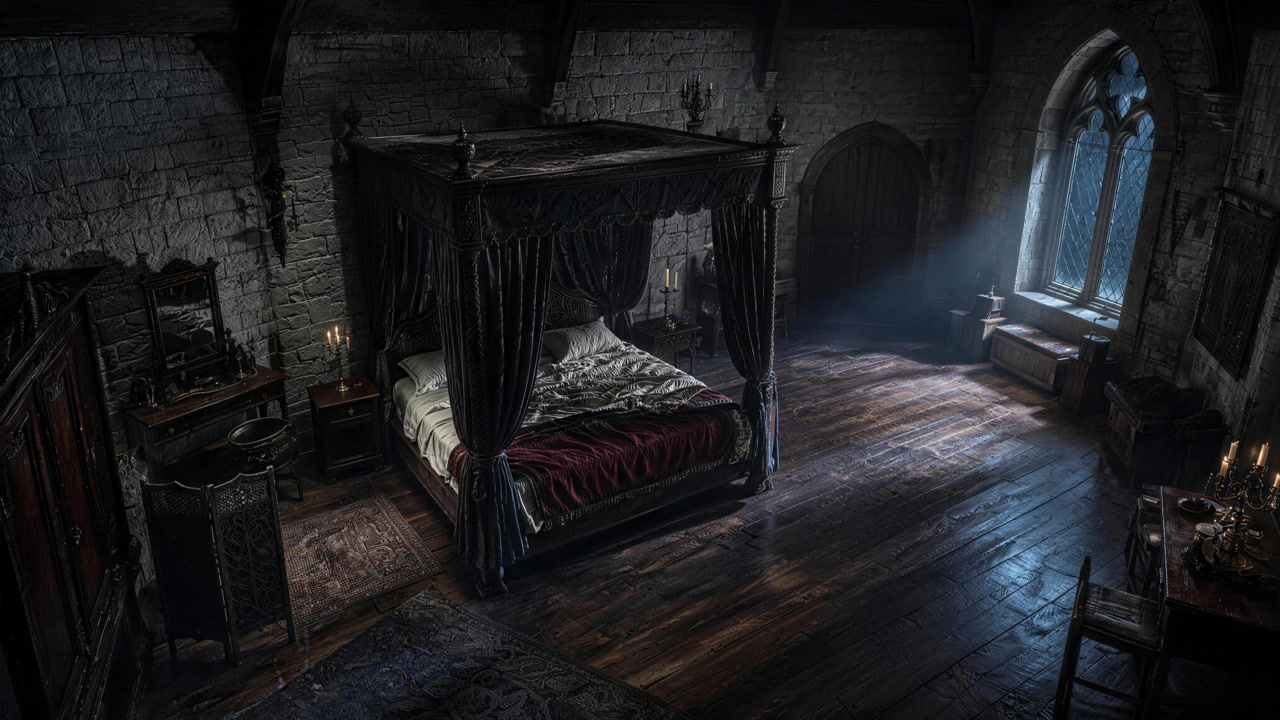
Course visual reference preview
Create a cinematic, ultra-photorealistic medieval Gothic bedroom at night in a 16:9 aspect ratio. The room is completely empty, with no people present. Position the camera high in the front-left corner of the room, looking downward at approximately a 45-degree angle through a 20mm ultra-wide-angle lens. Show the entire bedroom clearly. A large, dark, intricately carved wooden four-poster bed stands slightly left of center. It has a heavy black fabric canopy and thick black velvet curtains hanging around it. The bed is slightly unmade, with naturally wrinkled ivory sheets and pillows. A deep burgundy velvet coverlet lies across the foot of the bed. The room is enclosed by rough, dark-gray stone walls and heavy exposed timber ceiling beams. The floor consists of aged, dark, wide wooden planks. On the right wall is a tall Gothic pointed-arch window with leaded glass panes. Cold blue moonlight enters diagonally through the window, creating a soft but clearly visible shaft of light and window-frame shadows across the wooden floor. A faint haze and floating dust particles are visible in the light. Place dark carved bedside tables, brass candlesticks, and burning candles on both sides of the bed. Against the left wall, include an antique wooden dressing table, a standing mirror, an ornate chair, and a washbasin. Beneath the window on the right, place wooden chests and a low cabinet. In the right foreground, include a long wooden table holding candles, cups, plates, and a few restrained medieval household objects. Several worn rugs with faded Eastern-inspired patterns lie across the floor. Preserve a large open area of bare wooden flooring on the right side and in the foreground. Use strong contrast between cold blue moonlight and dim, warm amber candlelight. Low-key lighting, deep black shadows, a quiet, oppressive, mysterious nighttime atmosphere. Historically believable materials, realistic stone, aged wood, velvet, metal, and fabric. The image should resemble a real historical film set rather than an illustration or fantasy game environment. Cinematic production design, HDR, deep depth of field, subtle 35mm film grain, highly detailed, grounded photorealism. Do not include people, silhouettes, modern furniture, electric lighting, text, watermarks, a fireplace, or exaggerated magical effects.
Course visual reference preview
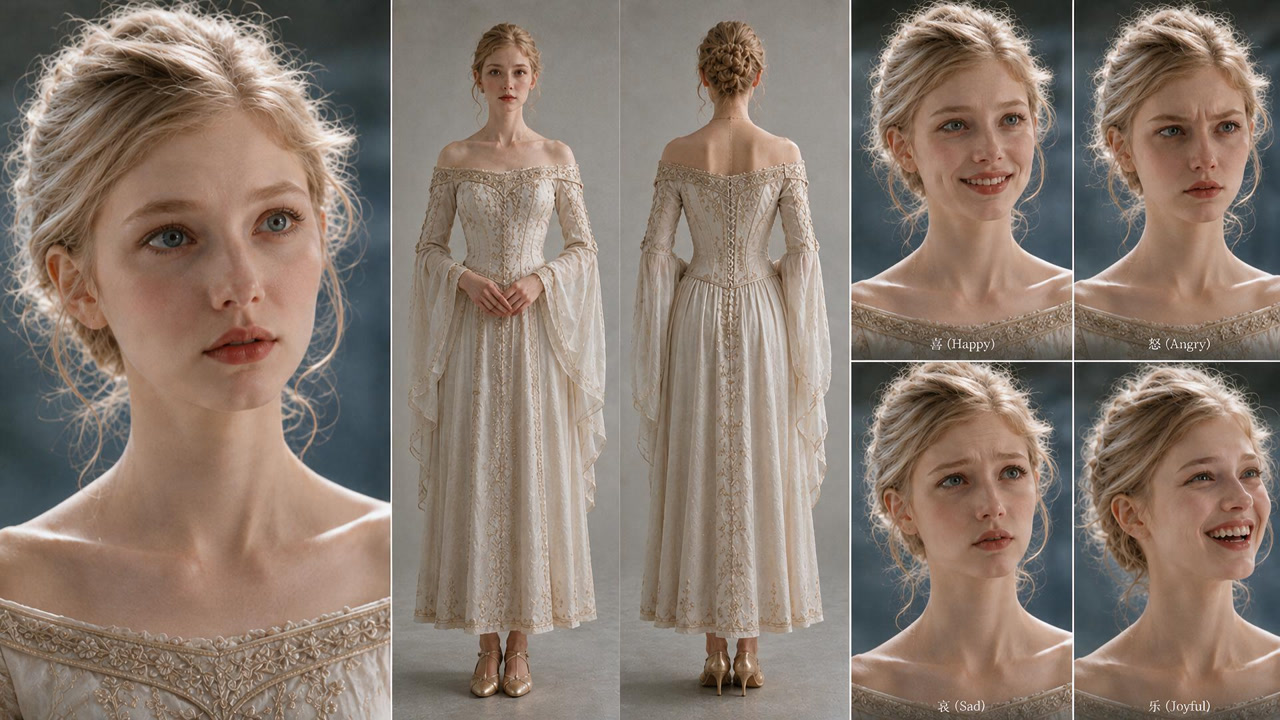
Create a horizontal 16:9 medieval female character reference sheet in an ultra-photorealistic live-action photography style. Every depiction must show exactly the same woman. Her facial anatomy, bone structure, facial features, age, hairstyle, hair color, eye color, costume, and body proportions must remain completely consistent throughout the entire image. The character is Amelia, a 22-year-old European noblewoman. She has a slender, graceful figure, elegant shoulders, and a long, delicate neck. Her skin is fair and translucent, with subtle natural freckles, visible pores, and realistic skin texture. She has a soft, narrow oval face with refined but naturally imperfect features, pale-blonde eyebrows, large gray-blue eyes, a clear and gentle gaze, a small straight nose, soft pale-pink lips, and a subtle natural blush. Her light flaxen-blonde hair is side-parted and arranged in an intricate braided low bun with a floral braided pattern. Leave a few naturally curled loose strands around her forehead, temples, and ears. She wears the same ivory medieval noblewoman’s gown in every panel. The gown has an off-the-shoulder neckline, a fitted corseted bodice, and fine pale-gold floral and vine embroidery along the neckline, bodice, waist, and skirt. The sleeves widen below the elbows into long, soft, layered, split bell sleeves. The skirt falls naturally to her ankles and is made from soft ivory silk and linen. She wears champagne-gold vintage heels. The front and back construction of the costume must remain logically consistent. Use the following exact layout: LEFT SECTION — approximately 28% of the image: A large head-and-shoulders beauty portrait of Amelia. She is shown in a subtle three-quarter view, looking slightly upward and away from the camera with a calm, thoughtful expression. Use an 85mm portrait lens and shallow depth of field. Emphasize her consistent facial features, gray-blue eyes, realistic skin, fine freckles, and illuminated blonde flyaway hairs. CENTER SECTION — approximately 34% of the image: Show two full-body views of the same character side by side: one from the front and one from the back. In the front view, Amelia stands upright with dignified posture and her hands gently folded at her waist. In the back view, clearly show her elaborate braided bun, bare shoulders, corseted back, embroidery, sleeves, and full skirt. Both figures must be completely visible from head to toe without cropping. Maintain accurate anatomy and identical body proportions. RIGHT SECTION — approximately 38% of the image: Create a 2×2 grid of four head-and-shoulders portraits. Use the same camera position, crop, lighting, hairstyle, costume, and facial identity in all four panels. Top left: a soft, restrained smile — Happy. Top right: tightly furrowed brows and controlled, determined anger — Angry. Bottom left: moist eyes and a vulnerable, sorrowful expression — Sad. Bottom right: turning slightly to the side with a bright, open, joyful laugh — Joyful. At the bottom of the four expression panels, add small, elegant white serif captions exactly as follows: “喜 (Happy)” “怒 (Angry)” “哀 (Sad)” “乐 (Joyful)” Use a clean, warm-gray studio wall as the background. Separate the sections with thin white lines. Soft overcast window light enters from the upper left, with a subtle rim light around the hair. Low-saturation colors, gentle classical tones, and live-action photographic realism. The final result should resemble a premium film-casting portrait, costume-design archive, and professional character turnaround sheet. Show realistic skin texture, fine embroidery, natural fabric folds, consistent white balance, and high-resolution detail. Do not change the character’s identity, face shape, hair color, eye color, hairstyle, costume, or accessories between panels. No additional people, duplicate limbs, incorrect anatomy, modern elements, anime styling, artificial plastic skin, watermarks, or unrelated text.
Course visual reference preview
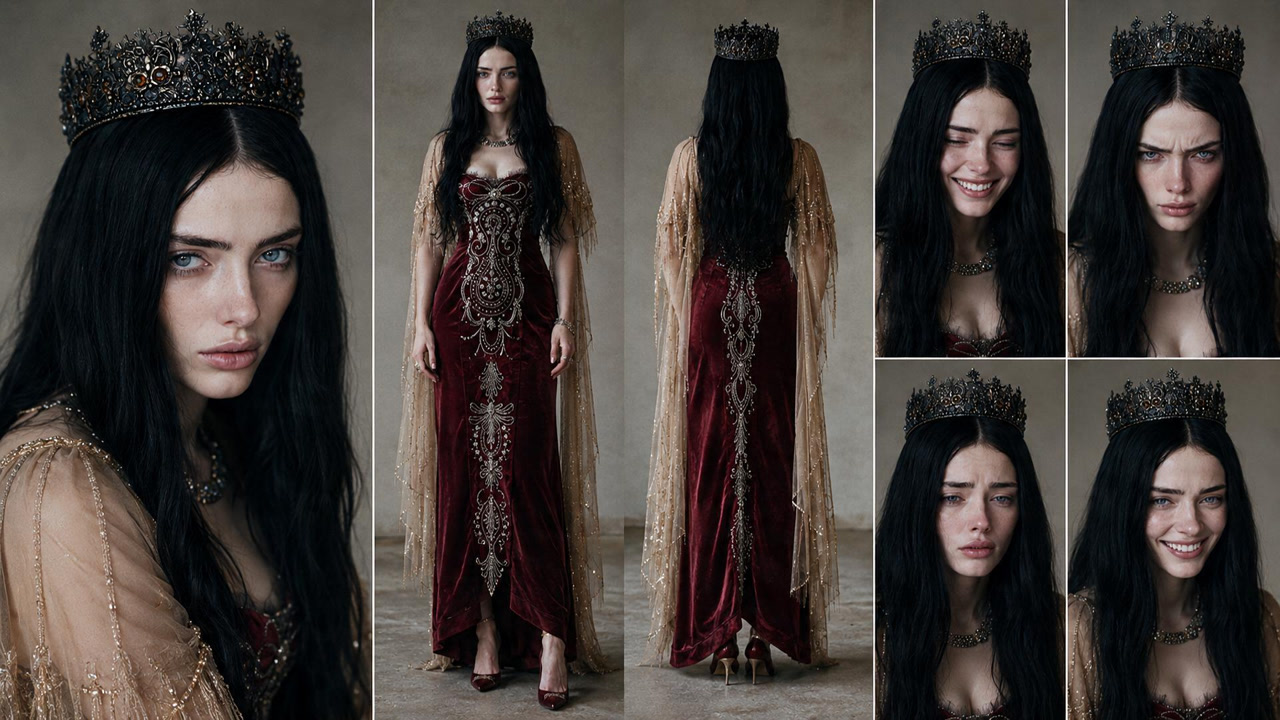
Create a horizontal 16:9 medieval dark-royalty female character reference sheet in an ultra-photorealistic live-action photography style. Every depiction must show exactly the same woman. Her facial anatomy, bone structure, facial features, age, hairstyle, crown, costume, accessories, and body proportions must remain completely consistent throughout the entire image. The character is Vanessa, a 26-year-old European royal princess. She is tall and slender, with a dangerous, arrogant, and magnetic presence. She has cool, pale skin with subtle natural freckles across her nose and cheeks. Preserve visible pores and realistic skin texture. Her face is long and narrowly oval, with sharply defined contours, high cheekbones, a narrow straight nose, full natural nude-pink lips, thick dark eyebrows, and piercing pale gray-blue eyes. Her expression and gaze should feel cold, intelligent, and threatening. Her dense, jet-black hair is center-parted, naturally wavy, and falls all the way to her waist. She always wears the same large Gothic royal crown. The crown is made from blackened silver metal with elaborate openwork, pointed filigree, intertwined vines, and fleur-de-lis motifs. It is set with dark-red gemstones and a few black stones. The crown must feel ancient, heavy, intimidating, and genuinely royal—not like a modern beauty-pageant tiara. She wears the same deep-burgundy royal gown in every panel. It is a fitted dark-red velvet column gown with a structured low-neckline corseted bodice. The chest, waist, abdomen, and center of the skirt are decorated with elaborate symmetrical gold and antique-silver beadwork, metallic embroidery, and gemstones. A long, translucent champagne-gold tulle cape drapes from her shoulders to the floor. The fabric is decorated with vertical gold bead chains, sequins, and fine hanging fringe. She wears a heavy antique-gold gemstone necklace and deep-burgundy heels. The front and back construction of the costume must remain logically consistent. Use the following exact layout: LEFT SECTION — approximately 28% of the image: A large head-and-shoulders portrait of Vanessa. Her body is slightly turned away while her head turns toward the camera. She stares directly into the lens with a cold, guarded expression. Clearly show her crown, black hair, freckles, pale gray-blue eyes, and distinctive facial structure. Use an 85mm portrait lens with shallow depth of field and realistic skin texture. CENTER SECTION — approximately 34% of the image: Show two full-body views of the same character side by side: one from the front and one from the back. In the front view, Vanessa stands still with both arms resting naturally at her sides, clearly displaying the elaborate central embroidery of the gown. In the back view, clearly show the crown, waist-length black hair, translucent cape, rear embroidery, gown construction, and heels. Both figures must be completely visible from head to toe without cropping. Maintain accurate anatomy and identical body proportions. RIGHT SECTION — approximately 38% of the image: Create a 2×2 grid of four head-and-shoulders portraits. Use the same camera position, crop, lighting, hairstyle, crown, costume, and facial identity in every panel. Top left: eyes closed with an exaggerated, delighted smile. Top right: deeply furrowed brows and a hostile, furious stare. Bottom left: moist eyes, exhaustion, vulnerability, and sadness. Bottom right: a charming but calculating smile with a subtle sense of malice. Do not add any captions or text. Use a muted warm gray-brown plaster wall and gray stone floor as the background. Separate the sections with thin white lines. Soft overcast natural window light, premium fashion-editorial photography, low-saturation medieval colors, and slightly cool gray shadows. The final image should resemble a high-end film character casting portrait, royal costume archive, and professional character turnaround sheet. Add subtle 35mm film texture and highly realistic skin, velvet, tulle, metal, embroidery, beads, and gemstones. Do not change the character’s identity, facial structure, eye color, hairstyle, crown, costume, or jewelry between panels. No additional people, duplicate limbs, incorrect anatomy, modern elements, anime styling, artificial plastic skin, watermarks, captions, or text.
+ See how this was madeMore detailed steps inside the course
Process 03

Direct the Film

Turn your story and references into video directions that move like film.

Motion 01
Motion 02
Motion 03
+ See how this was madeMore detailed steps inside the course

See What's Possible

Made Entirely With AI

A unique film built from one story, using the same 3-step system.

How This Film Was Built

The same creative logic works for every story, scene, and world.

Process 01

Story Blueprint

Turn your own idea into a clear cinematic story.

Outline 01

2s · 105mm Side shot on the lower half of D’s face as he raises a gauntlet to adjust it. Only part of the gauntlet enters frame. Behind him, heavily blurred guards become loose blocks of colour, talking and laughing without intelligible dialogue. Hold the focus on D’s controlled movement and let the room feel active but distant. Keep the background soft, layered, and crowded; the stillness in D’s face should carry the tension before anything has happened.

Outline 02

3s · 105mm Frame the table by the doorway while guards gamble, roll dice, laugh, shout, and point at one another. A blurred shoulder fills the foreground. Pan slowly toward the open door and let the image move from blur into clarity. Faint fighting and screams drift in from outside, but nobody in the room reacts at first. The shot needs to establish the room’s rhythm, the doorway’s threat, and the moment when a familiar space begins to feel unsafe.

Outline 03

7s · 85mm A steps forward with a cold, controlled expression and pulls a stack of guard masks from her waist. In the final seconds, move to a tighter close-up as she releases the masks, scans the room, and asks, “Where is Elara?” Keep every reaction in the room delayed and restrained. The scene should move from quiet observation to confrontation through posture, timing, focal length, and the sudden weight of a single line of dialogue.

+ See how this was madeMore detailed steps inside the course
Process 02

Build the World

Create references that make characters and scenes feel consistent.
Course visual reference preview
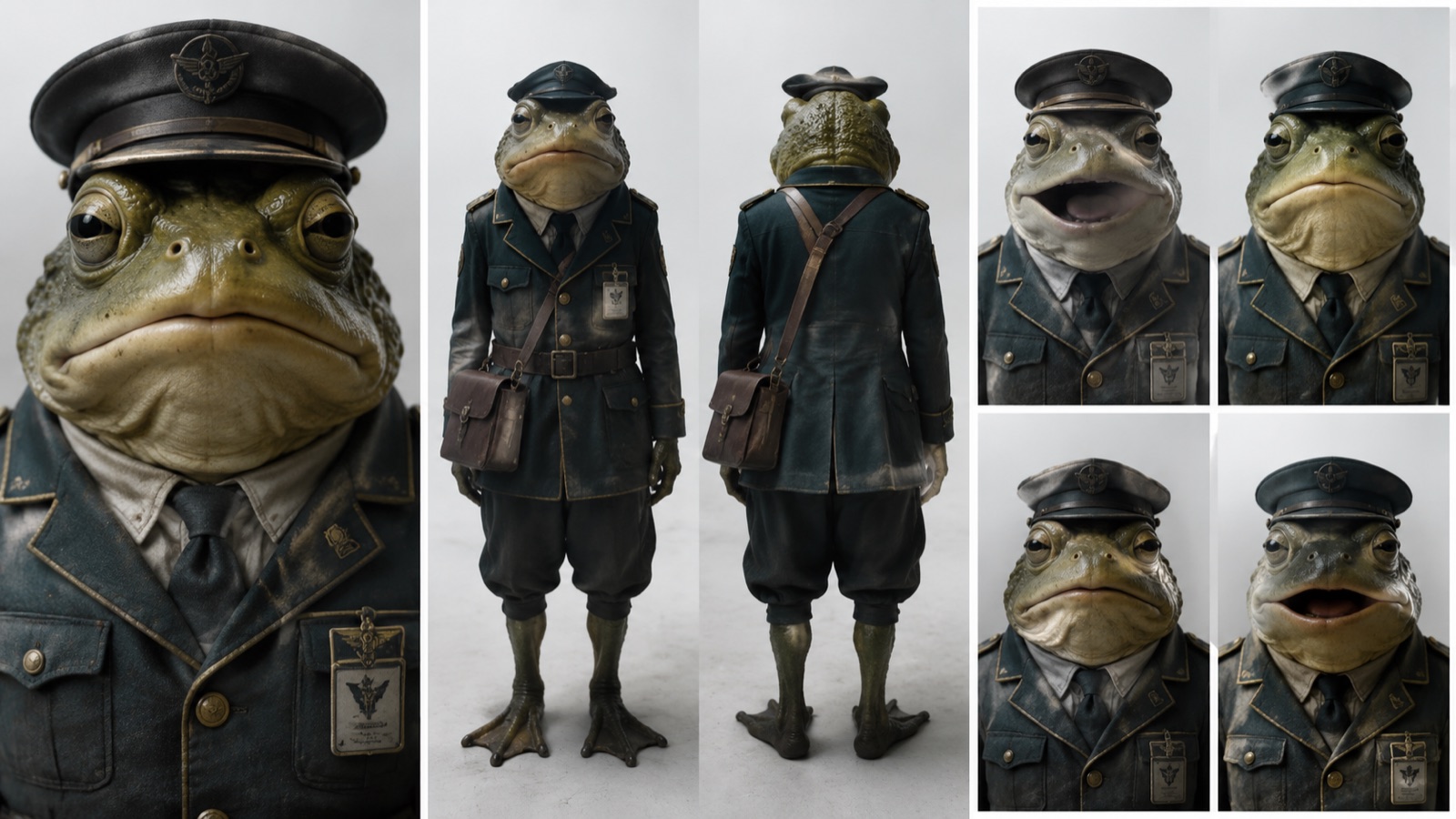
Create full-body front and back reference views for a timid frogfolk document inspector at a medieval airship harbor. Build the frame as a complete character sheet: a close portrait on the left, dual full-body views in the middle, and a small emotion grid on the right. Preserve realistic pores, fine body hair, uneven pigmentation, documentary texture, and a clean face. Use an 80mm Phase One look with soft overcast window light and restrained 35mm grain.
Course visual reference preview
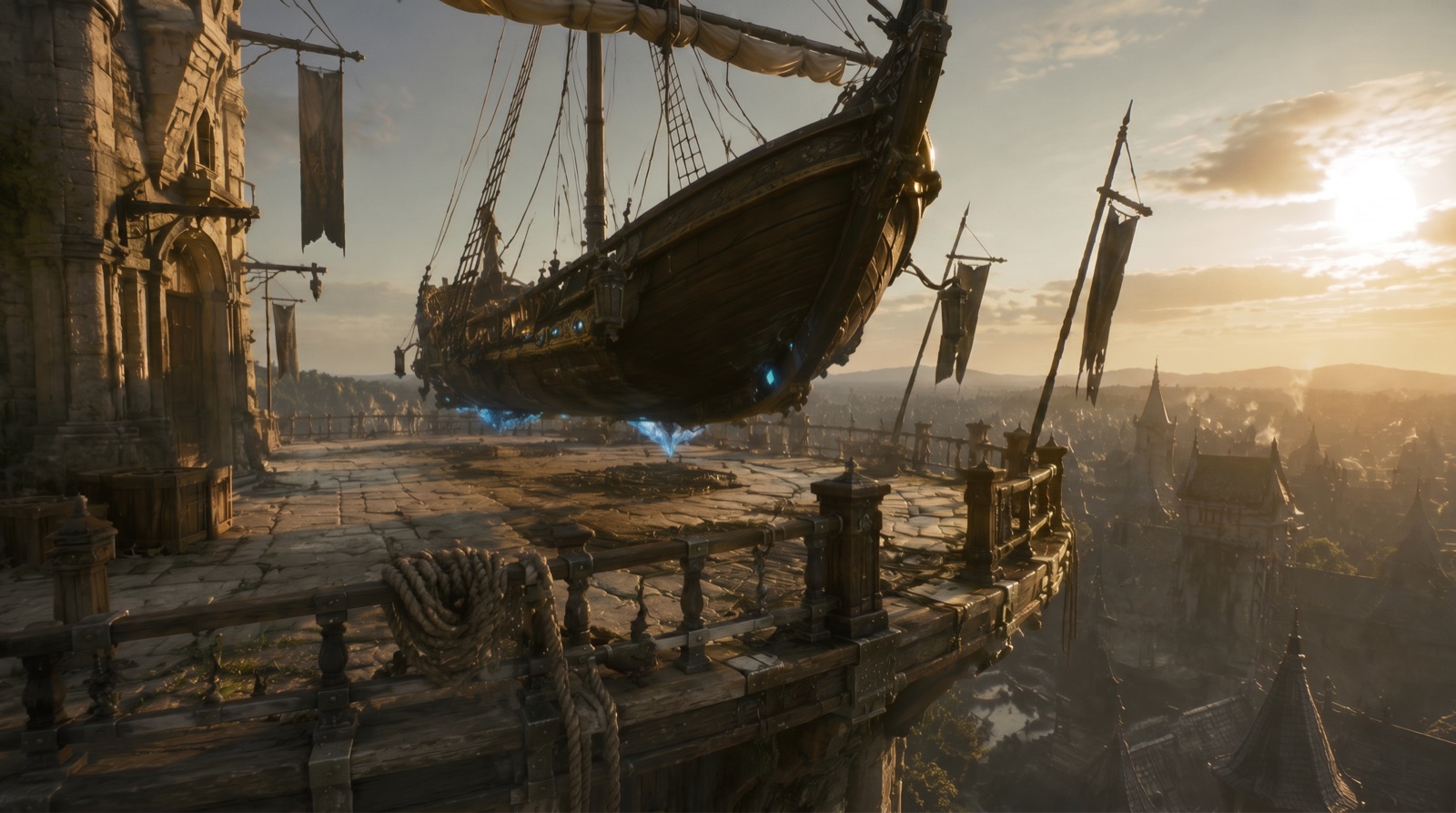
Create a cinematic still of a medieval magical-era airship docking platform on the sixth floor of a stone tower castle. Show weathered stone, mooring ropes, iron railings, wooden crates, a dark-wood airship, aged bronze rune-metal, and faintly glowing crystals. Beyond the platform, layer towers and streets into a blue atmospheric haze. Use late-afternoon light, a 28mm wide lens, deep focus, warm sun against cool crystal light, and a quiet sense that an adventure is about to begin.
Course visual reference preview
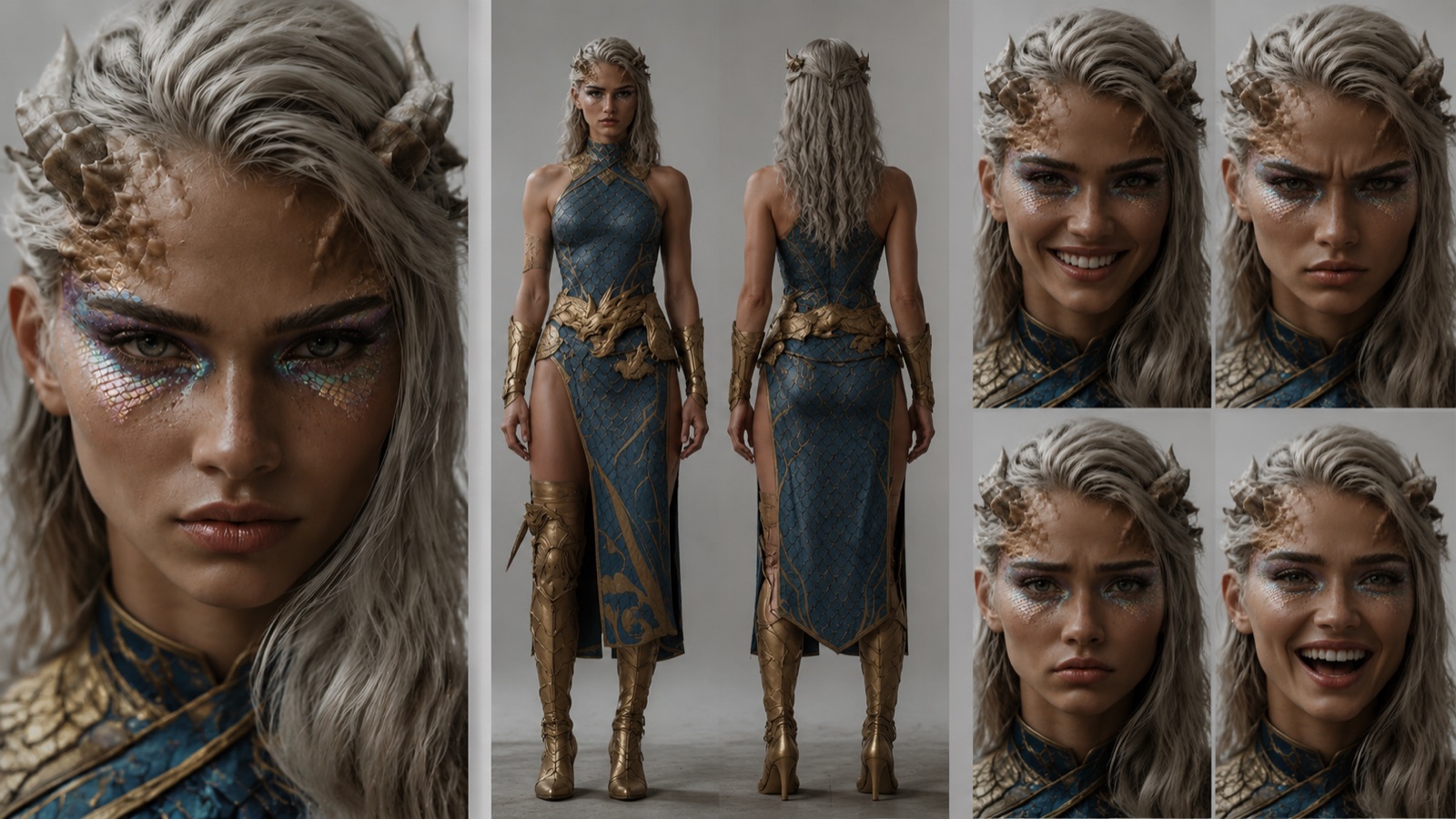
Create a dragonwoman character sheet using the provided wardrobe reference. Show front and back full-body views, a detailed portrait, short horns, eye makeup, a short sword, and four clear emotional expressions. Keep the proportions tall and editorial, but preserve unretouched documentary skin texture, subtle pores, fine body hair, natural uneven pigmentation, and no beauty treatment. Use the same overcast 80mm Phase One visual language so the character stays consistent from prompt to prompt.
+ See how this was madeMore detailed steps inside the course
Process 03

Direct the Film

Turn your story and references into video directions that move like film.

Motion 01
Motion 02
Motion 03
+ See how this was madeMore detailed steps inside the course

One Method. A New World.

Same 3 Steps. Different Film.

A repeatable process for any story, style, or world.

How This Film Was Built

The same creative logic works for every story, scene, and world.

Process 01

Story Blueprint

Turn your own idea into a clear cinematic story.

Outline 01

2s · 105mm Side shot on the lower half of D’s face as he raises a gauntlet to adjust it. Only part of the gauntlet enters frame. Behind him, heavily blurred guards become loose blocks of colour, talking and laughing without intelligible dialogue. Hold the focus on D’s controlled movement and let the room feel active but distant. Keep the background soft, layered, and crowded; the stillness in D’s face should carry the tension before anything has happened.

Outline 02

3s · 105mm Frame the table by the doorway while guards gamble, roll dice, laugh, shout, and point at one another. A blurred shoulder fills the foreground. Pan slowly toward the open door and let the image move from blur into clarity. Faint fighting and screams drift in from outside, but nobody in the room reacts at first. The shot needs to establish the room’s rhythm, the doorway’s threat, and the moment when a familiar space begins to feel unsafe.

Outline 03

7s · 85mm A steps forward with a cold, controlled expression and pulls a stack of guard masks from her waist. In the final seconds, move to a tighter close-up as she releases the masks, scans the room, and asks, “Where is Elara?” Keep every reaction in the room delayed and restrained. The scene should move from quiet observation to confrontation through posture, timing, focal length, and the sudden weight of a single line of dialogue.

+ See how this was madeMore detailed steps inside the course
Process 02

Build the World

Create references that make characters and scenes feel consistent.
Course visual reference preview
Create full-body front and back reference views for a timid frogfolk document inspector at a medieval airship harbor. Build the frame as a complete character sheet: a close portrait on the left, dual full-body views in the middle, and a small emotion grid on the right. Preserve realistic pores, fine body hair, uneven pigmentation, documentary texture, and a clean face. Use an 80mm Phase One look with soft overcast window light and restrained 35mm grain.
Course visual reference preview
Create a cinematic still of a medieval magical-era airship docking platform on the sixth floor of a stone tower castle. Show weathered stone, mooring ropes, iron railings, wooden crates, a dark-wood airship, aged bronze rune-metal, and faintly glowing crystals. Beyond the platform, layer towers and streets into a blue atmospheric haze. Use late-afternoon light, a 28mm wide lens, deep focus, warm sun against cool crystal light, and a quiet sense that an adventure is about to begin.
Course visual reference preview
Create a dragonwoman character sheet using the provided wardrobe reference. Show front and back full-body views, a detailed portrait, short horns, eye makeup, a short sword, and four clear emotional expressions. Keep the proportions tall and editorial, but preserve unretouched documentary skin texture, subtle pores, fine body hair, natural uneven pigmentation, and no beauty treatment. Use the same overcast 80mm Phase One visual language so the character stays consistent from prompt to prompt.
+ See how this was madeMore detailed steps inside the course
Process 03

Direct the Film

Turn your story and references into video directions that move like film.

Motion 01
Motion 02
Motion 03
+ See how this was madeMore detailed steps inside the course

Not Just Prompts

What You’ll Learn

Prompts are only part of the process. You’ll learn the Oneframe Method behind building films that are original, repeatable, and truly yours.

The Oneframe Story-Tuning Method: turn a blank idea into a distinctive cinematic story without writing a full, complicated screenplay.

The creative decision-making behind story, visual references, and video direction — so you can adapt the system to any new world or genre.

Custom-tuned Oneframe SKILL workflows, examples, and prompt structures that accelerate execution without replacing your creative control.

Real film breakdowns that explain why each creative decision works — not just what to copy.

Ongoing updates for active members, including new workflows, examples, and Oneframe SKILL refinements.

Annual Membership

Create the World You Love

The complete creative system for making original films — not a library of copy-and-paste prompts.

After purchase, you’ll receive a private Notion invitation at your checkout email within one business day.

$599

per year

Get the Course